
Energy retrofit for apartment buildings without equity
Old gas or oil heating, poor energy class, no appetite for a six-figure investment: this is how owners of apartment buildings improve the energy class by up to five levels without putting in their own capital.
The problem: retrofitting costs money, doing nothing costs more
Apartment buildings in energy classes G and H are offered on average around 28 percent below comparable class A properties. Banks assess the energy performance with every financing, the CO2 levy on gas and oil rises every year, and the Building Energy Act requires 65 percent renewable energy for new heating systems. At the same time, tradespeople, materials and interest rates are as expensive as rarely before. Many owners are stuck: they cannot afford to retrofit, and waiting gets more expensive every year.
The solution: buy heat instead of owning a heating system
With heat contracting, a provider takes over the entire heat generation in the building. It converts the old boiler room, finances the technology and operates it over the contract term. The owner only buys the result: heat and hot water at a fixed price per kilowatt hour over 10 to 15 years. The provider bears the conversion costs, the owner's capital stays in the property.
What gets installed
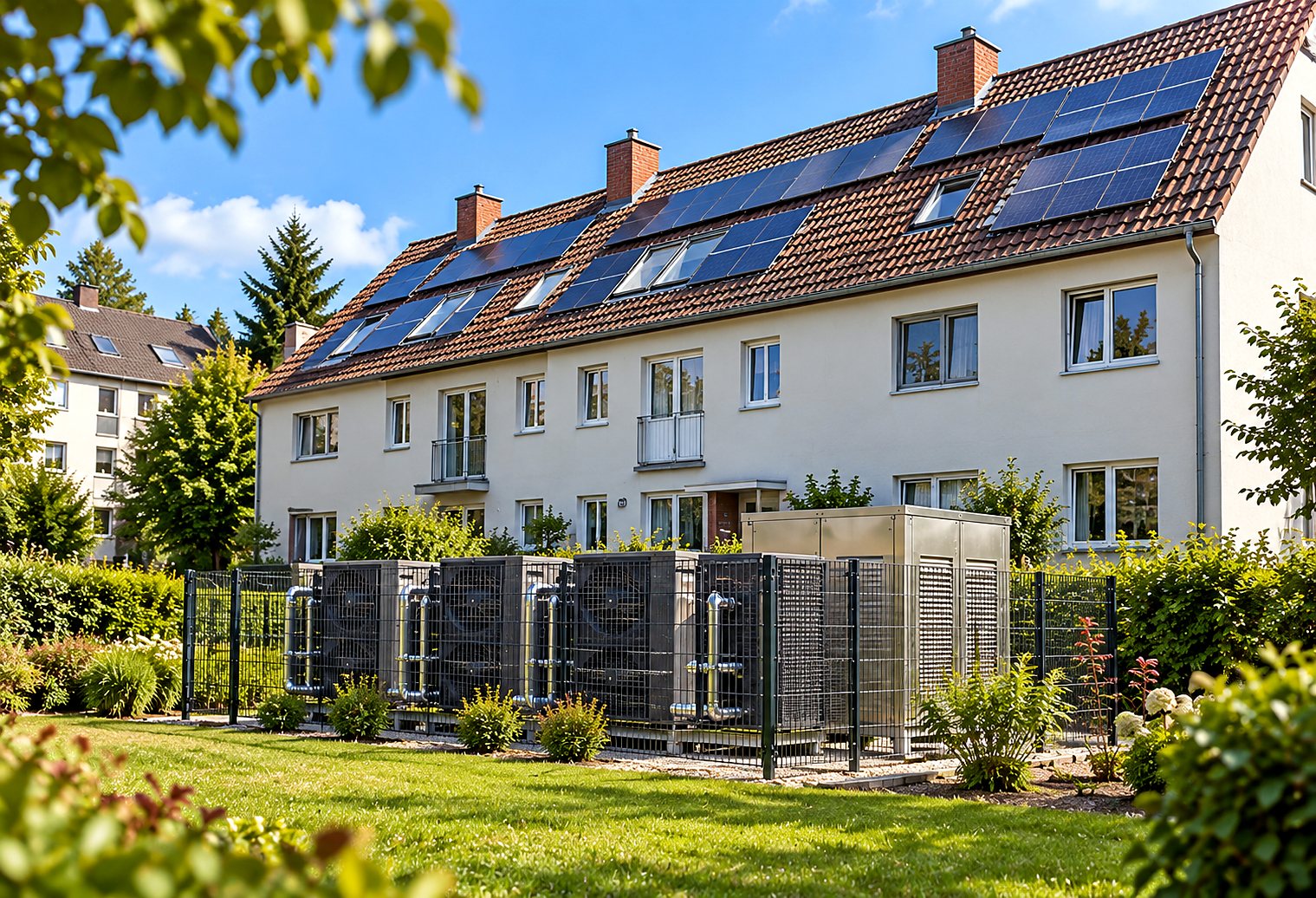
- Heat pumps replace boiler and burner. The storage tank goes into the basement, the outdoor units stand next to the building or on the roof.
- Photovoltaics on the roof supply the electricity for operation where the building allows it.
- Learning controls with sensors and valves on the existing pipe network balance the risers hydraulically and lower the flow temperature. Up to 40 percent less energy consumption.
Work takes place in the boiler room, on the building and on the roof. No scaffolding on the facade, no access to the apartments, operation continues.
Result: up to five energy classes better
Because primary energy demand drops drastically with heat pumps, the energy class on the certificate improves by up to five levels depending on the starting point, for example from G to B. The property leaves the category of renovation case. The discount disappears on sale, the bank reassesses on financing, and tenants' heating costs become predictable.
| Topic | Own retrofit | Heat supply |
|---|---|---|
| Conversion costs | Owner | Provider |
| Planning, financing, maintenance | Owner | Provider |
| Facade, scaffolding, apartments | usually required | not required |
| Heat price | fluctuates with the market | fixed for 10 to 15 years |
| Energy class | depends on scope | up to 5 classes better |
Which buildings qualify
- From 8 residential units. Apartment building, no upper limit. We assess several buildings of one owner together.
- Central heating system. One system for the building. Individual gas boilers per flat do not qualify.
- Energy class E or worse according to the certificate. For district heating we also look at better classes.
- One owner for the whole building. Owners' associations do not qualify.
- Heating costs run through the owner, who passes them on to tenants.
How it works
- Submit the property. Address and key data, plus energy certificate and heating cost statements of the last three years. Takes two minutes.
- Calculation. We check the key data and align the design with the provider. Feedback usually within 5 working days.
- Offer and technical review. Written offer with a guaranteed price per kilowatt hour, site visit of boiler room, floor space and roof.
- Contract. Heat supply contract between owner and provider, then scheduling of the installation.
What it costs
Assessment, site visit and offer are free of charge and without obligation for owners. The provider bears the conversion costs. You pay the agreed heat price per kilowatt hour, fixed over the term. Kola NetZero is paid by the provider; the heat supply contract is concluded directly between you and the provider.
Frequently asked questions
Can I really retrofit my apartment building without my own money?
Yes, for the heat generation. With heat contracting the provider plans, finances, builds and operates the new boiler room with heat pumps, photovoltaics and controls. You pay no conversion costs but a fixed price per kilowatt hour of heat over 10 to 15 years. Facade insulation and windows are not part of the model, but are usually not needed to improve the energy class.
How many energy classes are realistic?
Depending on the starting point up to five classes, for example from G to B. The jump comes from heat pumps drastically reducing primary energy demand compared with gas or oil, and from the learning controls cutting consumption by up to 40 percent.
Which buildings qualify?
Apartment buildings from 8 residential units with a central heating system, energy class E or worse, one owner for the whole building, heating costs running through the owner. For district heating we also look at better classes, from 50 units we assess exceptions individually.
What changes for tenants?
Tenants receive heat as before and pay for it through the service charge statement. Switching to heat supply is regulated in section 556c of the German Civil Code: the costs may not exceed the previous operating costs. The apartments do not need to be entered for the conversion.
How long until I receive an offer?
After submission we usually check the key data within 5 working days. Then follows the site visit of the boiler room and the roof, after that the written offer with a guaranteed price per kilowatt hour.
What does the assessment cost?
Nothing. Assessment, site visit and offer are free of charge and without obligation for owners. Kola NetZero is paid by the provider.
Free assessment in two minutes.
Energy certificate and heating cost statements are enough to start. Feedback within 5 working days.
Check property ↗